What happened
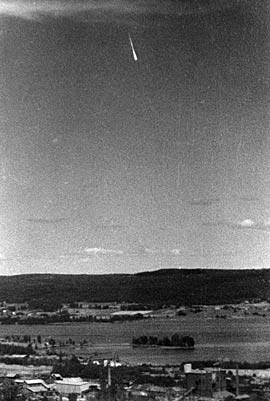
In the summer of 1946, a year after Germany's V-weapons fell silent, Swedes began reporting 'ghost rockets': fast rocket- or cigar-shaped objects, sometimes winged, sometimes glowing balls trailing smoke, crossing the sky by day and night. Some made hissing or rumbling sounds; others were silent and flew level or even manoeuvred. About 2,000 sightings were logged between May and December, peaking on 9 and 11 August. On 19 July witnesses at Lake Kölmjärv in Norrbotten watched a grey, winged, rocket-like object plunge into the lake with a great waterspout. Air Force officer Karl-Gösta Bartoll led a search of nearly three weeks and found the lake bottom disturbed but no wreckage. The Swedish government set up a special ghost rocket committee, censored reports of exact locations, and briefed American visitors General James Doolittle and RCA head David Sarnoff. The Defence Staff said in October that some observations could not be explained. By year's end the wave had faded.

The official explanation
Investigators concluded that many reports were meteors; the August peaks coincide with the Perseid meteor shower, and debris sent to the Swedish National Defence Research Institute (FOA) was identified as coke, slag or meteoritic material. At the time the leading theory was Soviet tests of captured German V-1 or V-2 technology from Peenemünde, and a Top Secret memo from US Central Intelligence Group director Hoyt Vandenberg to President Truman in August 1946 leaned that way. But no recognisable rocket fragments were found, and there is no record of launches from Peenemünde after early 1945, so the Soviet theory was rejected by Swedish, British and US investigators.
The anomalous case
The Swedish military took the wave seriously enough to reactivate wartime radars, form a 38-member expert committee and impose press censorship. A committee draft memo of 3 December 1946 reported nearly a hundred impacts, thirty pieces of debris examined, and 225 of 973 reports classed as observations of real physical objects, all seen in broad daylight. Bartoll, who searched Lake Kölmjärv, reported signs the object had disintegrated and was probably made of a light alloy that left no trace on instruments, and told researcher Clas Svahn in 1984 that what people saw were real, physical objects. Sarnoff told The New York Times he was convinced the ghost bombs were real missiles. A declassified 1948 USAFE intelligence document says Swedish air intelligence officers thought some objects reflected a technology not attributable to any known culture on Earth.
The strongest argument that this was something genuinely unknown or classified, with each claim attributed to the person who made it.


Documents
- Project 1947: A Ghost Rocket Chronology (Joel Carpenter), part 1 report, project1947.com
- Project 1947: A Ghost Rocket Chronology, part 3 (late 1946, including the 3 December committee memo) report, project1947.com
Sources
- Ghost rockets Wikipedia
- Guided Missiles and UFOs: A Tangle of Fear 1937-53 (Ghost Rocket chronology) by Joel Carpenter Project 1947
- Ghost Rocket chronology, parts 2-3 Project 1947
Witness reports elsewhere
These archives can't be republished here, so we link to them instead.