What happened
Around 4 a.m. on 20 September 1977, early-shift dockworkers, police officers and an ambulance crew in Petrozavodsk watched a brilliant 'star' rise from the north-east and swell into something like a glowing jellyfish hanging over the city. For several minutes it showered the streets with fine rays that witnesses compared to falling rain, then shrank to a bright semicircle and drifted off toward Lake Onega, some said punching a reddish hole through the clouds. TASS correspondent Nikolai Milov filed the first report, and it ran in Pravda and Izvestia. Similar lights were reported that night from Helsinki and Leningrad's Pulkovo airport to the White Sea, and Nordic governments asked Moscow whether a weapons test had been conducted. The Soviet Academy of Sciences sent experts, compiled a restricted report and admitted it could not satisfactorily explain what was seen. The event helped launch Setka, a state research programme on anomalous atmospheric phenomena run with the Defence Ministry until the end of the Soviet era.

The official explanation
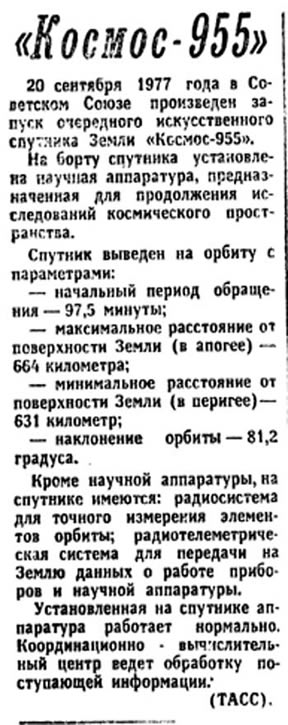
James Oberg attributed the spectacle to the pre-dawn launch of the Soviet satellite Kosmos-955 from Plesetsk at about 03:58 local time: exhaust from the rocket, lit by the sun at high altitude while the ground was dark, can form expanding glowing shells now often called 'space jellyfish'. Physicist Yuli Platov, who led the Soviet research programme, endorsed the launch explanation in the 1980s and later added that a failed ballistic missile test nearby contributed some effects. Other Soviet scientists suggested aurora or chemiluminescence.
The anomalous case
The Academy's own investigators did not accept the satellite answer at the time. Sternberg Institute astronomer Lev Gindilis pointed out that the main object was reported moving from north-east to south-west, while Kosmos-955 flew north-east, and that some sightings were logged before the launch. A 1978 appendix to the Academy report stressed those earlier sightings, and the restricted report floated 'a possible influence of some cosmic agent'. A clinical psychologist assessed nine witnesses and vouched for their sanity, and an engineer at Kurkijoki described a faceted, window-lit airship-like body hundreds of metres up. Ukrainian researcher Oleh Pruss, who served 18 years at the Kapustin Yar launch range, said he knew what rocket launches looked like and Petrozavodsk was something different.
The strongest argument that this was something genuinely unknown or classified, with each claim attributed to the person who made it.


Sources
- Petrozavodsk phenomenon Wikipedia
- Little Green Men: A Look at the Official Soviet X-Files Investigation The Moscow Times
Witness reports elsewhere
These archives can't be republished here, so we link to them instead.