What happened
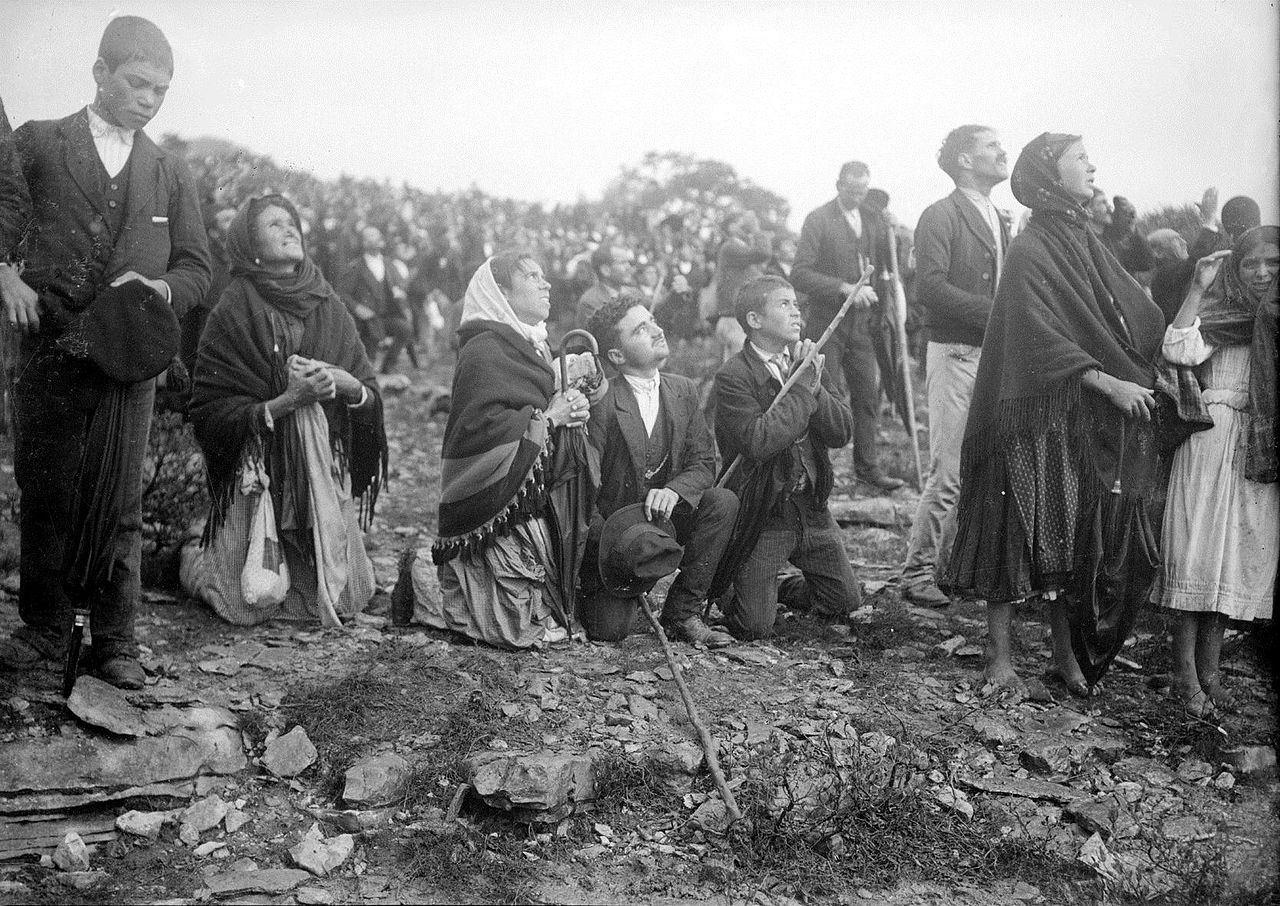
Through 1917, three shepherd children near the Portuguese village of Fátima, Lúcia dos Santos and her cousins Francisco and Jacinta Marto, said a radiant lady was appearing to them on the 13th of each month, and that in October she would perform a miracle so that all would believe. On 13 October a crowd of tens of thousands, many sceptical and including reporters from Lisbon's anticlerical press, stood in heavy rain at the Cova da Iria. Around midday the clouds parted and, witnesses said, the Sun appeared as a dull silver disc that could be looked at directly. It seemed to spin, throw off coloured light across the landscape, then plunge toward the crowd in a zig-zag before returning to its place, in an episode lasting roughly ten minutes. Many said their soaked clothes were suddenly dry. Not everyone saw the same thing, and some saw nothing. Newspapers across Portugal carried the story, and in 1930 the Church declared the visions worthy of belief.

The official explanation
Scientists and sceptics attribute the reports to optical and psychological effects. Physicist Auguste Meessen argued in 2003 that retinal after-images and bleaching of photoreceptors from staring toward the Sun produce exactly the dancing and colour effects reported, and that similar 'sun miracles' occur at many pilgrimage sites. Joe Nickell points to the Sun seen through thin cloud as a silver disc, shifting cloud density, sundogs and the expectations of a primed crowd. Steuart Campbell (Journal of Meteorology, 1989) proposed stratospheric dust; others suggested Saharan dust. Critics note that observatories saw nothing unusual, and witness accounts conflict.
The anomalous case
This is one of the largest mass sightings ever recorded, it was predicted months in advance for a specific day, and many witnesses were hostile to religion, including the journalist from the anticlerical O Século who wrote it up. Accounts describe a silver disc that rotated, changed colour, plunged toward the crowd in a zig-zag, gave off heat and dried soaked clothing and ground, features that echo later close-encounter reports. At the September apparition, encyclopaedic accounts record a globe of light descending and white flakes that dissolved before reaching the ground, which ufologists liken to 'angel hair' in later cases. Priest and philosopher Philippe Dalleur, analysing shadows in photographer Judah Ruah's crowd photographs, argued there were two light sources and that distant witnesses placed the 'silver sun' toward Fátima rather than at the Sun's true position.
The strongest argument that this was something genuinely unknown or classified, with each claim attributed to the person who made it.
Sources
- Miracle of the Sun Wikipedia
- Fatima (Encyclopedia of Occultism and Parapsychology; New Catholic Encyclopedia) Encyclopedia.com
Witness reports elsewhere
These archives can't be republished here, so we link to them instead.