What happened
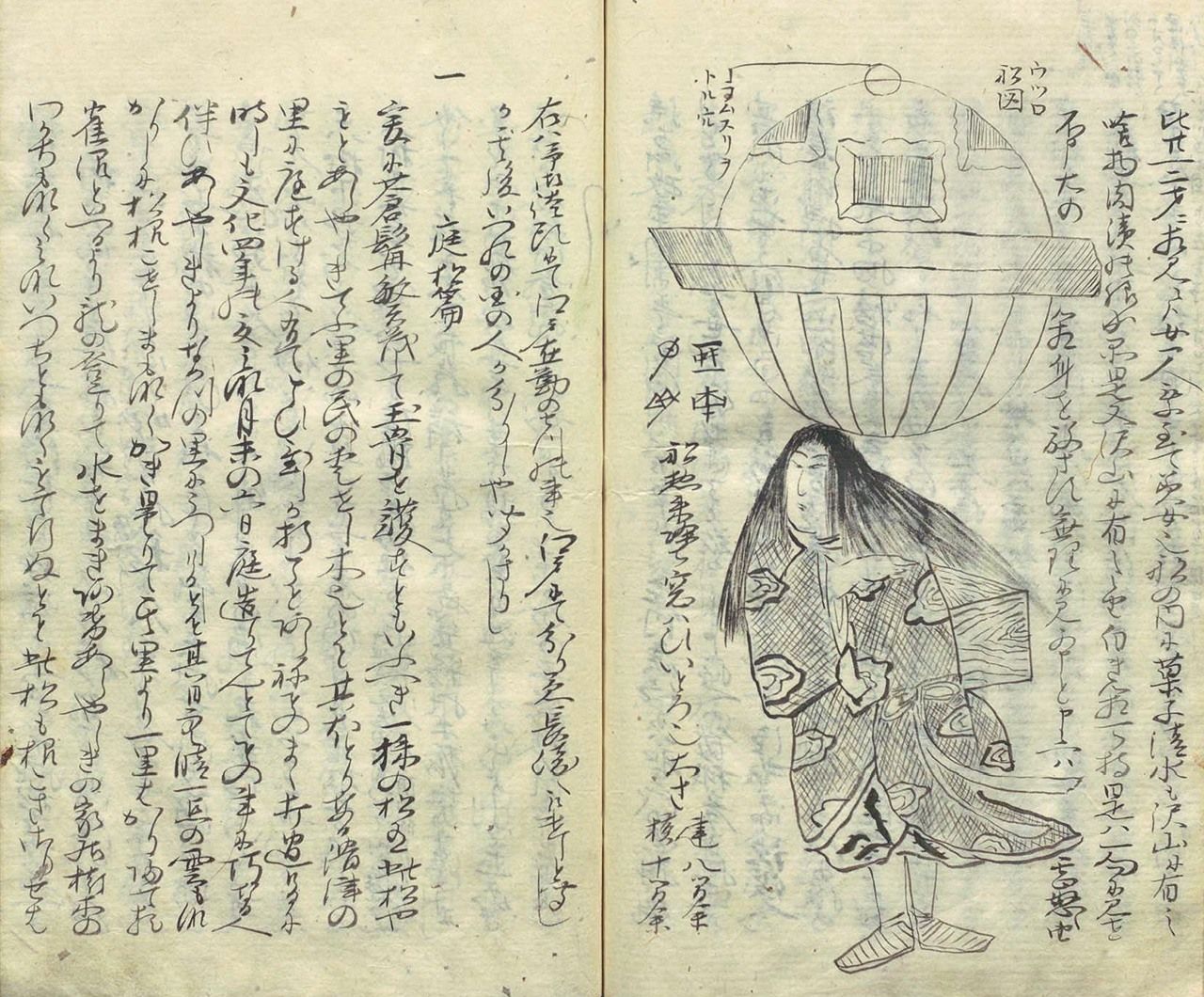
In 1803, according to several Edo-period manuscripts, fishermen on the Hitachi coast of eastern Japan towed ashore a strange round vessel. The best-known version, in the 1825 collection Toen shosetsu edited by Kyokutei Bakin, describes a craft about 3.3 metres high and 5.5 metres wide, shaped like an incense burner, with a lacquered upper half, a lower half sheathed in metal plates, and barred windows of glass or crystal. Inside was a young woman, perhaps 18 to 20, with pale skin and red hair and brows, dressed in unfamiliar fabric. She spoke no language anyone recognised and clutched a box she would let no one touch. Unknown symbols were written inside the vessel. The villagers, unwilling to take on the cost and risk of reporting her, are said to have put her back in the craft and pushed it out to sea. Accompanying sketches of the domed, windowed vessel and its script have made the tale a staple of ancient-astronaut writing.


The official explanation
Most historians treat the story as folklore. The folklorist Yanagita Kunio regarded all utsuro-bune tales as groundless, and similar 'hollow boat' legends of foreign princesses set adrift go back centuries in Japan. Physicist Tanaka Kazuo of Gifu University, who has collected about a dozen versions, notes that the place names in most texts cannot be found, but one manuscript (the Banke document) names a real beach at Hasaki in Kamisu. He suggests a brief real incident may have been merged with the local Princess Konjiki silkworm legend, possibly promoted by a nearby temple. Bakin himself compared the woman's dress and red hair to descriptions of Russian women, and a foreign shipwreck or castaway is another conventional reading. The script may be decorative pseudo-European lettering.
The anomalous case
The account survives in at least four independent texts written between about 1815 and 1844, and Tanaka has located around eleven related documents, so this was not a single writer's invention. They agree on striking particulars: a round, sealed, metal-plated vessel with transparent windows, a sealed box, and writing nobody could read. Nothing in early-19th-century Japanese or European boatbuilding matches a small round metal-bottomed craft with glazed portholes washing up with a lone occupant. The sketches resemble the domed, windowed 'saucer' shape later reported worldwide, which is why ufologists cite the case as a possible landing. Tanaka himself has said an alien script cannot be ruled out, though he offers no evidence for it. If one manuscript genuinely preserves a real place name, as Tanaka argues of the Banke document, the core event may be historical.
The strongest argument that this was something genuinely unknown or classified, with each claim attributed to the person who made it.

Sources
- 'Utsurobune': A UFO Legend from Nineteenth-Century Japan Nippon.com
- Utsuro-bune Wikipedia
Witness reports elsewhere
These archives can't be republished here, so we link to them instead.