What happened
In summer 1566 the people of Basel saw three unsettling sky events, described in an illustrated broadsheet the same year. On the evening of 27 July the sun lost its brilliance, looked no bigger than the full moon and seemed to weep blood, and the nearly full moon turned blood-red overnight. At sunrise the next day the sun bathed houses and streets in fiery red light. Then, at dawn on 7 August, large black spheres were seen in front of the sun, moving at speed as if fighting. Many turned fiery red, broke apart and went out. The broadsheet was printed by Samuel Apiarius with the Zurich artist and printer Samuel Coccius; the Swiss National Museum notes that neither man witnessed the events. Its woodcut shows Basel Cathedral and the Munsterplatz under a sky full of dark and light balls. The sheet survives in the Wickiana collection in Zurich.
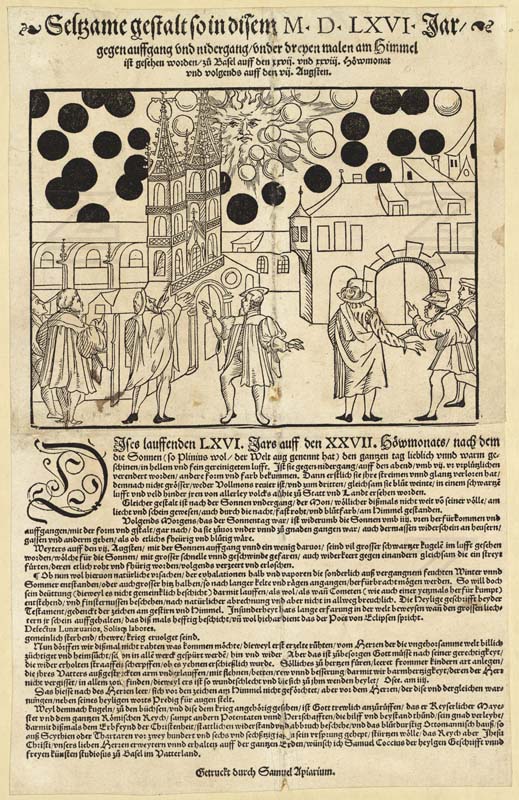

The official explanation
The first two episodes, a dim, reddened sun and a blood-red moon and dawn, fit dust or smoke high in the atmosphere, and the red moon may have been a lunar eclipse. Proposed explanations for the black spheres include sunspots or after-images seen by people staring at a dimmed sun, atmospheric dust, meteors and other optical effects. The Swiss National Museum notes that most scholars favour natural causes. Like the Nuremberg sheet, the broadsheet is a work of religious instruction, urging repentance in a period of war and confessional fear.
The anomalous case
The Basel sheet describes a repeating phenomenon over eleven days, not a single flash, and the last episode involves many separate dark spheres. They move quickly and with apparent precision in front of the sun, seem to engage one another, and some glow red before breaking up and going out. That is close to the swarming, colour-changing orbs of modern reports. The sheet stresses that the whole city and the surrounding countryside saw it, and it was published within the year. It also fits a cluster of similar reports in the same region within five years, including Nuremberg in 1561, which ufologists argue points to a real wave of aerial phenomena over the German-speaking lands rather than a single printer's invention.
The strongest argument that this was something genuinely unknown or classified, with each claim attributed to the person who made it.
Documents
- Basel broadsheet, 1566 (Wikimedia Commons scan) newspaper, commons.wikimedia.org
Sources
- The celestial event over Basel in 1566 Swiss National Museum blog
- 1566 celestial phenomenon over Basel Wikipedia
- File:LinkSeltsame Gestalt so in disem MDLXVI Jar.jpg Wikimedia Commons
Witness reports elsewhere
These archives can't be republished here, so we link to them instead.